
You toss a stack of old tax returns into a basic office shredder and feel a sense of relief. But could someone actually piece those strips back together? With identity theft, corporate espionage, and strict data protection laws on the rise, understanding shredder security levels is no longer optional. It’s a frontline defense for your personal and professional data.
Not all shredders offer the same protection. The difference between a budget strip-cut model and a certified micro-cut machine can mean the difference between regulatory compliance and a costly data breach. Choosing the right level protects your clients, your business, and your legal standing.
In this guide, you’ll learn exactly what each security level means, which one your situation requires, and how to match your documents to the right level of destruction.
How Shredder Security Levels Work
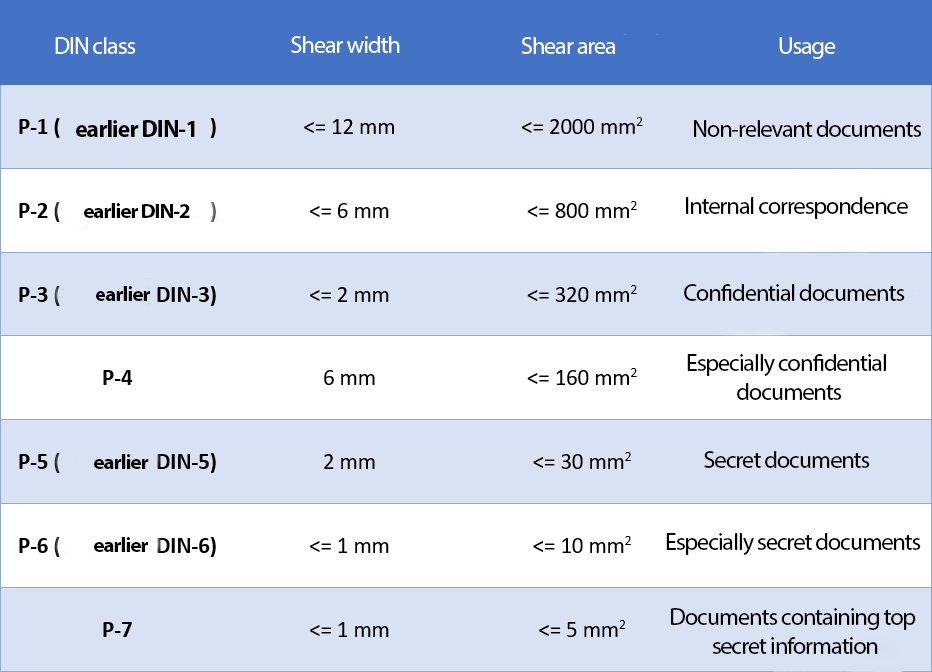
Modern shredder security follows the global ISO/IEC 21964 standard, which replaced the older German DIN 66399 system. This framework defines seven paper-specific levels, labeled P-1 through P-7, based on the maximum size of shredded particles. Smaller particles mean harder reconstruction and stronger security.
The “P” prefix specifically refers to paper-based products. Separate standards exist for other media like optical discs, hard drives, and microfilm. Within the paper category, each level corresponds to a maximum strip width and particle area, creating a clear scale from basic destruction to top-secret elimination.
Choosing the wrong level isn’t just inefficient. It can violate laws like HIPAA, GDPR, FACTA, and the Sarbanes-Oxley Act, exposing you to fines, lawsuits, and reputational damage.
P-1: Strip-Cut for Non-Sensitive Materials
P-1 shredders slice paper into long strips up to 12 mm wide, with a maximum particle area of 2,000 mm². These machines are fast, affordable, and can often handle staples and paperclips without jamming.
The trade-off is minimal security. The strips are wide enough to read entire lines of text, and reassembly is easy with basic tools or even by hand. This level is appropriate only for materials with zero sensitive content.
Best for: Junk mail, flyers, packaging labels, and general home or office clutter.
P-2: Narrower Strips for Slightly Better Protection
P-2 reduces strip width to 6 mm and particle area to 800 mm². While the cut is still strip-based (not cross-cut), the narrower width makes casual reconstruction slightly more tedious.
However, the fundamental vulnerability remains. A password, account number, or signature can still sit intact on a single strip. P-2 offers only marginal improvement over P-1 and should never be used for personal or financial information.
Best for: Print shops, bulk disposal of non-confidential internal documents.
P-3: Cross-Cut for Confidential Office Documents
P-3 marks the shift to cross-cut technology, which slices paper both horizontally and vertically. Particles are no wider than 2 mm, with a maximum area of 320 mm², roughly the size of a small fingernail.
This level creates confetti-like pieces that are significantly harder to reassemble. While reconstruction is theoretically possible with enough time and effort, it’s impractical for most attackers. P-3 is often considered the minimum level for “confidential” business documents.
Best for: Schools, small businesses, home offices handling tax records or HR files.
P-4: The Industry Standard for Legal Compliance
P-4 is the gold standard for commercial shredding. With a maximum particle area of 160 mm², reconstruction becomes extremely difficult, if not impossible, without specialized forensic tools.
This level is the accepted minimum for compliance with HIPAA (healthcare) and FACTA (financial services) in the United States. It protects sensitive PII, patient records, loan applications, and client contracts while still offering reasonable speed for daily office use.
If you work in law, healthcare, or finance, P-4 is your baseline. Anything lower risks non-compliance and potential fines.
Best for: Medical offices, law firms, financial institutions, and corporate compliance departments.
P-5: Micro-Cut for Highly Sensitive Data

P-5 uses micro-cut technology to produce particles as small as 30 mm², with a maximum width of 2 mm. The result is a fine confetti that’s nearly impossible to piece back together.
While not required for most commercial regulations, P-5 adds critical protection for highly sensitive but unclassified information. Think patent applications, R&D documents, business contracts, and confidential government files.
The trade-off is reduced speed and sheet capacity. P-5 shredders process fewer pages per pass and require regular maintenance to prevent jams. For organizations handling intellectual property or sensitive negotiations, this upgrade is well worth the investment.
Best for: R&D departments, law firms handling mergers, corporations with proprietary data.
P-6: Super Micro-Cut for Extreme Security
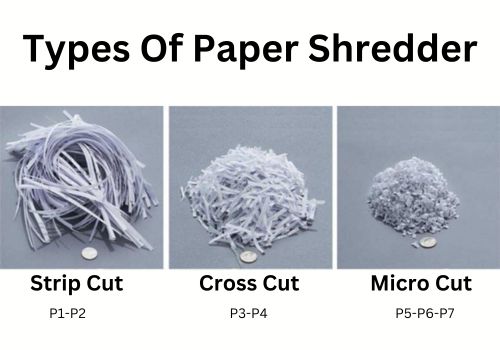
P-6 pushes security further with particles limited to 10 mm² and 1 mm width. These shreds resemble coarse dust, making manual reconstruction effectively impossible.
P-6 occupies a unique niche. It’s more secure than P-5 but does not meet NSA standards for top-secret classification (that requires P-7). Some agencies, including the U.S. Army under Regulation 380-5, accept P-6 for specific classified materials.
These machines are slow, expensive, and sensitive to foreign objects. They typically cannot process staples, paperclips, or credit cards and require strict pre-sorting of materials.
Best for: Defense contractors, federal agencies, security firms handling sensitive but not top-secret materials.
P-7: NSA-Certified Top-Secret Destruction
P-7 is the highest possible shredder security level. Particles are no larger than 5 mm² and 1 mm wide, with a strict requirement that no more than 4 characters appear on any single shred.
This is the only level certified by the NSA/CSS for destroying top-secret classified information. The output resembles dust, making reconstruction scientifically implausible.
P-7 shredders are the slowest in the spectrum, processing approximately 10 sheets per pass. They require meticulous maintenance, are expensive to purchase and operate, and are highly susceptible to jamming. Most organizations with large volumes of classified material use professional shredding services instead.
Best for: Military operations, intelligence agencies, top-secret government facilities.
Speed vs. Security: The Inevitable Trade-Off
There’s a clear inverse relationship between shred fineness and operational speed. As security increases, throughput decreases.
High Speed, Low Security (P-1 and P-2)
Strip-cut shredders can handle 15–20 sheets per pass and run continuously for bulk waste. They’re built for volume, not data protection.
Balanced Performance (P-3 and P-4)
Cross-cut models offer the best compromise for daily office use. They process 6–10 sheets per pass at moderate speeds while delivering strong security.
Low Speed, High Security (P-5 to P-7)
Micro-cut and super micro-cut machines are slow by design. The finer the cut, the more mechanical stress on the blades and the higher the jam risk. These machines are built for precision, not volume.
Pro Tip: If you need P-5 or higher for large volumes, consider a professional shredding service. They use industrial-grade equipment and provide a certificate of destruction for compliance audits.
Material Limits by Security Level
Higher security levels have stricter material requirements. The precision cutting heads in P-5 and above can be damaged by staples, paperclips, and other foreign objects.
| Level | Staples | Paperclips | Credit Cards | CDs/DVDs |
|---|---|---|---|---|
| P-1 / P-2 | Often OK | Sometimes | Some models | Some models |
| P-3 / P-4 | Most models | Avoid | Some models | Some models |
| P-5 / P-6 | Remove first | Remove first | Avoid | Avoid |
| P-7 | Never | Never | Never | Never |
Always remove metal before feeding documents into P-5 or higher machines. Also avoid shredding wet paper, laminated sheets, or plastic, as these can damage any shredder.
Matching Security Levels to Your Industry

Your industry determines your minimum legal requirement. Using the wrong level can void compliance and expose you to significant penalties.
Healthcare (HIPAA)
HIPAA requires secure disposal of Protected Health Information (PHI). While the law doesn’t specify a particle size, enforcement actions and legal precedents point to P-4 as the minimum. Many facilities use P-5 or P-7 for highly sensitive research or case files.
Financial Services (FACTA, GDPR, Sarbanes-Oxley)
The Fair and Accurate Credit Transactions Act mandates secure disposal of consumer financial data. P-4 is the accepted standard for credit reports, loan applications, and account statements. GDPR requires “appropriate technical measures,” which P-4 meets in most cases.
FACTA violations can result in fines up to $4,000 per incident. GDPR fines can reach 4% of global revenue.
Government and Defense (NSA Standards)
For unclassified but sensitive government data, use P-4 or P-5. For secret or top-secret information, P-7 is mandatory. P-6 may be accepted under specific regulations, but P-7 is the only level with full NSA/CSS certification.
Corporate and Legal
General offices should use P-3 or P-4 for HR files and internal memos. For R&D, patents, or sensitive legal case files, P-5 is strongly recommended to prevent corporate espionage and intellectual property theft.
Quick Reference: Matching Documents to Security Levels
| Document Type | Minimum Level | Ideal Level |
|---|---|---|
| Junk mail, flyers | P-1 | P-1 or P-2 |
| Internal memos | P-2 | P-3 |
| HR records, student files | P-3 | P-4 |
| Patient files, tax returns | P-4 | P-5 |
| Legal contracts, patents | P-5 | P-5 or P-6 |
| Classified intelligence | P-6 | P-7 |
Key Buying Tips
- Match security to sensitivity. Don’t overbuy a P-7 for junk mail or underbuy a P-2 for medical records.
- Verify certification. Ensure the shredder is certified to ISO 21964 / DIN 66399, not just labeled “P-4.”
- Plan for volume. High-security shredders are slow. For large batches, use a professional service.
- Future-proof your choice. Data laws are tightening. Choosing P-4 over P-3 gives you room to grow.
- Get a certificate of destruction. For audits, documentation from a professional service is invaluable.
Frequently Asked Questions About Shredder Security Levels
What is the difference between strip-cut and cross-cut shredders?
Strip-cut shredders slice paper into long strips, while cross-cut shredders cut both horizontally and vertically to create smaller confetti-like particles. Cross-cut offers significantly more security because the smaller pieces are much harder to reassemble.
Which shredder security level do I need for HIPAA compliance?
HIPAA does not specify an exact particle size, but industry standards and legal precedents point to P-4 as the minimum. For highly sensitive patient records or research data, many healthcare facilities opt for P-5 or higher.
Is a P-4 shredder good enough for tax documents?
Yes, P-4 is widely considered sufficient for personal tax documents and most financial records. If you want extra protection, P-5 offers enhanced security for sensitive financial data.
Can I shred credit cards in a high-security shredder?
Generally, no. P-5 through P-7 shredders are designed for paper only and can be damaged by credit cards, CDs, or other rigid materials. Always check your shredder’s specifications before shredding non-paper items.
What is the highest shredder security level available?
P-7 is the highest level, certified by the NSA/CSS for destroying top-secret classified information. It produces particles no larger than 5 mm² and is the only level that meets full NSA requirements for classified materials.
Do I need a P-7 shredder for my home office?
Almost certainly not. P-7 is designed for military, intelligence, and government use. For home offices, P-4 provides excellent security for personal documents while remaining practical and affordable.
Final Thoughts on Choosing the Right Shredder Security Level
Understanding shredder security levels is about more than buying equipment. It’s about protecting your data, your clients, and your reputation in an era of increasing privacy regulation. From P-1 strip-cut to P-7 NSA-certified micro-cut, each level serves a distinct purpose, balancing security, speed, and cost.
For most offices, P-4 is the sweet spot, secure enough for major regulations like HIPAA and FACTA while fast enough for daily use. If you handle patents, legal secrets, or classified data, stepping up to P-5, P-6, or P-7 is essential.
When in doubt, consider a professional shredding service. They handle the logistics, use industrial-grade equipment, and provide a certificate of destruction that proves your compliance during audits. Your data security is only as strong as your weakest link, so choose wisely and shred accordingly.