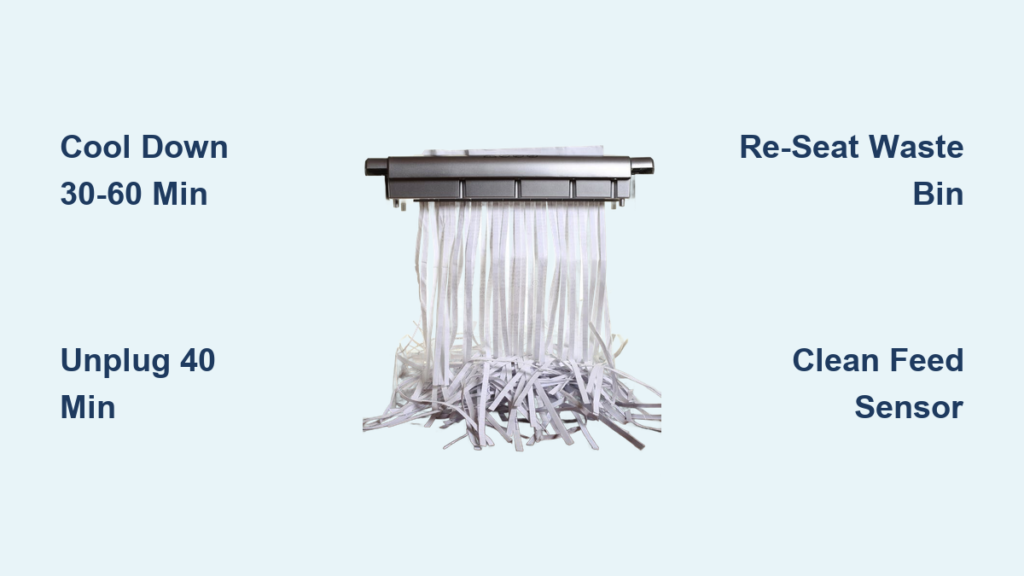
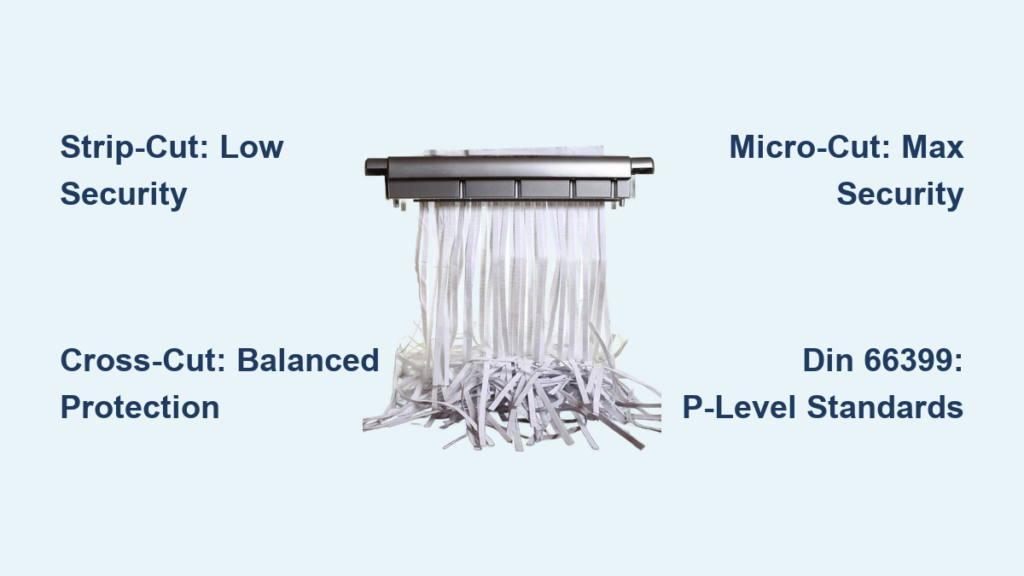
If you have ever tossed a credit card statement or old bank document into a shredder, you have likely trusted it to protect your data. But not all shredders are created equal, and the paper shredder cut type used determines whether your sensitive information is truly secure. From simple strip-cut models to high-security micro-cut destroyers, the way a shredder slices paper directly impacts how easily someone could reconstruct your documents.
Understanding paper shredder cut types is essential for anyone handling personal, financial, or confidential data. The difference between a basic office shredder and a top-tier security model comes down to particle size, cut pattern, and resistance to reconstruction. Thanks to international standards like DIN 66399, these cut types are now classified into clear security levels, from P-1 (minimal) to P-7 (top secret), making it easier to choose the right machine for your needs.
Strip-Cut Shredders: Fast but Low Security
Strip-cut shredders are the most basic type, using a single set of blades to slice paper vertically into long, ribbon-like strips. While they shred quickly and handle large batches, their security level is minimal, making them suitable only for non-sensitive materials.
How Strip-Cut Works
The mechanism pulls paper through rotating blades that cut straight down the page, producing long strips typically 3 mm to 12 mm wide and as long as the original sheet. Because only one cut direction is used, the motor encounters less resistance, allowing high-speed operation and sheet capacities of up to 30 pages at once in industrial models.
Why Reconstruction Is Easy
These long strips often retain readable lines of text, signatures, or account numbers, especially if the document was fed vertically (text running top to bottom). This flaw was famously exposed during the 1979 Iran Hostage Crisis, when U.S. embassy staff used strip-cut shredders, only for Iranian operatives to hand-reassemble critical documents.
With only about 40 shreds per page, strip-cut particles are large enough to allow “landscaping,” a term for reconstructing documents by aligning visible text fragments across strips.
When to Use Strip-Cut
Strip-cut shredders are appropriate for the following scenarios:
- Junk mail, flyers, and internal memos with no personal data
- High-volume environments prioritizing speed over security
- Never use for bank statements, IDs, contracts, or medical records
Ideal for: Home users clearing non-sensitive paper waste on a budget.
Cross-Cut Shredders: Balanced Security for Most Users
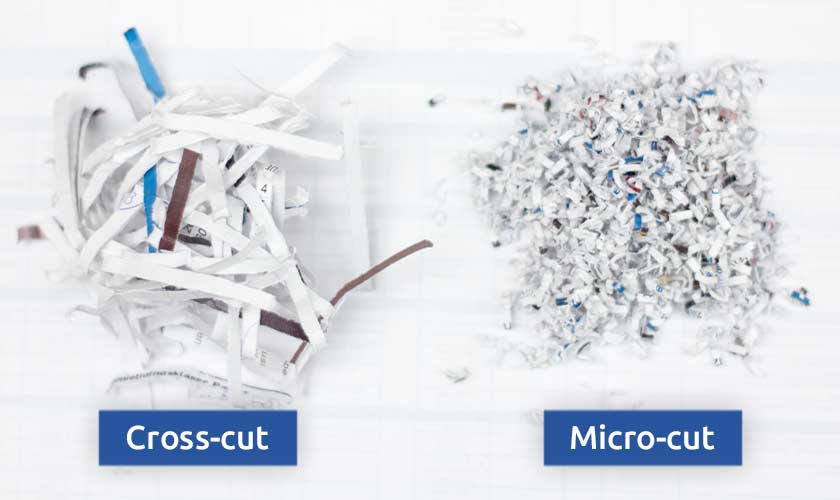
Cross-cut shredders, also known as confetti-cut, slice paper both vertically and horizontally, turning documents into small diamond or rectangle-shaped pieces. This dual-cut action dramatically increases security and reduces waste volume, making it the go-to choice for homes, offices, and small businesses.
Dual-Blade Mechanism Explained
Two sets of interlocking blades rotate perpendicularly: one cuts the paper into strips, and the second slices those strips into short segments. The result is tiny particles averaging 4 mm to 10 mm in size, depending on the security level.
For example:
- P-3 (Secure): ≤ 320 mm² particles (approximately 1/16″ x 1/2″)
- P-4 (Confidential): ≤ 160 mm² with max width of 6 mm
A standard page yields 200 to 400+ shreds, making manual reconstruction extremely time-consuming.
Resistance to Reassembly
While advanced forensic tools can theoretically reconstruct P-3 or P-4 shreds, doing so requires significant effort, scanning technology, and software algorithms. For most real-world threats, like dumpster diving or identity theft, cross-cut shredding provides strong, practical protection.
Feeding documents horizontally (text running left to right across the cut) further prevents line-by-line reconstruction.
Operational Trade-Offs
| Factor | Performance |
|---|---|
| Sheet Capacity | 6 to 15 sheets per pass |
| Speed | Moderate |
| Bin Fill Rate | Slower than strip-cut |
| Maintenance | Requires regular oiling |
| Cost | Mid-range ($100 to $300) |
Despite higher maintenance needs, cross-cut shredders offer the best security-to-efficiency ratio for everyday use.
Micro-Cut Shredders: Maximum Data Protection
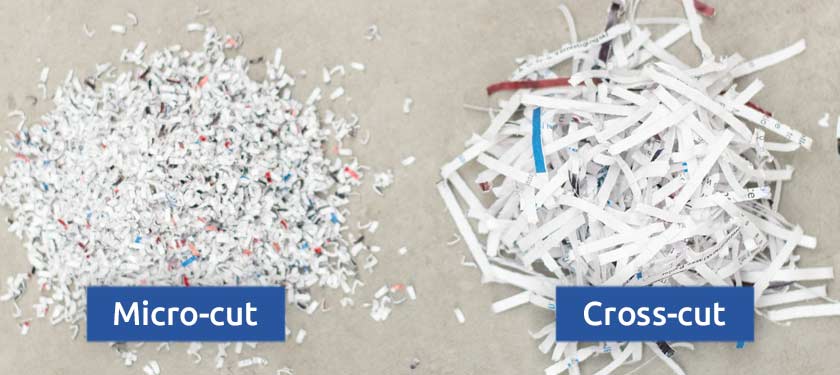
Micro-cut shredders deliver the highest level of security, reducing paper to dust-like particles so small they are nearly impossible to reassemble. Used by government agencies, financial institutions, and healthcare providers, these machines meet P-5 to P-7 standards under DIN 66399.
How Micro-Cut Achieves Maximum Security
Using densely packed, precision-aligned blades, micro-cut shredders make hundreds more cuts per page than cross-cut models. The resulting particles are tiny:
- P-5 (High): ≤ 30 mm² (approximately 1/64″ x 1/4″) equals about 2,000 shreds per page
- P-6 (Secret): ≤ 10 mm²
- P-7 (Top Secret): ≤ 5 mm² (practically powder) equals about 15,600 shreds per page
At P-7, reconstruction is considered forensically impractical without state-level resources.
Who Needs Micro-Cut
These shredders are essential when handling:
- Patient medical records (HIPAA compliance)
- Legal case files
- Financial transaction data
- Government or military intelligence
They are commonly found in:
- Law firms
- Hospitals
- Accounting offices
- Federal facilities
Performance and Maintenance Challenges
Due to extreme particle reduction, micro-cut shredders face real-world limitations:
- Low sheet capacity: Often 5 to 8 sheets max
- Slow shredding speed
- Frequent oiling required to manage fine dust and static
- Higher cost: $300 and up
- Noise and heat buildup in prolonged use
Despite these drawbacks, nothing surpasses micro-cut for data integrity.
DIN 66399 Security Levels Compared

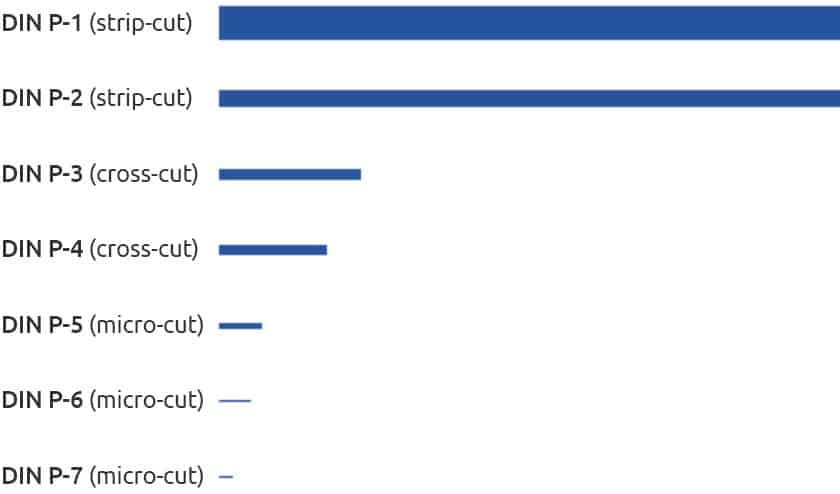
The DIN 66399 standard is the global benchmark for shredder security, defining seven protection levels (P-1 to P-7) based on particle size and data sensitivity.
Understanding the P-Level Scale
| Level | Classification | Max Particle Size | Suitable For |
|---|---|---|---|
| P-1 | General | ≤ 2,000 mm² or 12 mm strips | Internal notices, expired calendars |
| P-2 | Normal | ≤ 800 mm² or 6 mm strips | Non-confidential office paper |
| P-3 | Secure | ≤ 320 mm² | Emails, reports, non-sensitive personal data |
| P-4 | Confidential | ≤ 160 mm² | Bank statements, contracts, HR files |
| P-5 | High | ≤ 30 mm² | Medical records, financial data |
| P-6 | Secret | ≤ 10 mm² | Classified business info |
| P-7 | Top Secret | ≤ 5 mm² | National defense, intelligence |
This system allows organizations to match shredder capability to data risk.
Compliance with Data Laws
Using the correct P-level ensures adherence to key regulations:
- HIPAA: Requires P-4 or higher for patient records
- GDPR: Mandates appropriate disposal methods; P-4 recommended
- FACTA: Implies P-3 minimum for consumer financial data
- GLBA: Financial institutions must protect data; P-5 common
Always verify your industry is compliance requirements before purchasing.
Choosing the Right Cut Type by Use Case
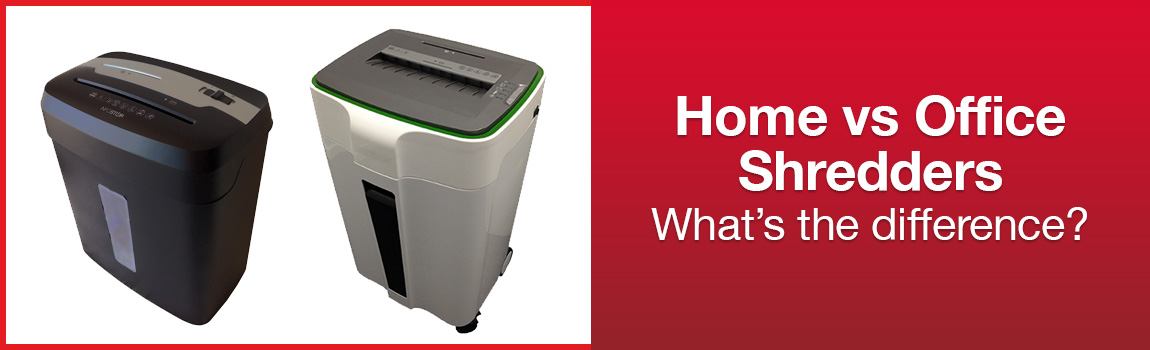
Your ideal shredder depends on what you are destroying, not just price or speed. Here is how to match cut type to real-world scenarios.
Home Users: Junk Mail vs. Financial Docs
- Only shredding flyers and ads? A strip-cut (P-1/P-2) is sufficient and cost-effective.
- Handling tax returns, bank statements, or insurance forms? Upgrade to cross-cut (P-4). It is affordable and prevents identity theft.
Pro Tip: Feed documents sideways (landscape) to break up text lines and reduce reconstruction risk.
Small Businesses: Meet Compliance Needs
Most small businesses handle customer data, invoices, or employee records, requiring P-4 cross-cut shredders as a baseline.
Avoid strip-cut entirely. Even basic HR forms contain PII (personally identifiable information) that could lead to liability if compromised.
Look for these essential features:
- Credit card and CD slots
- Pull-out waste bin
- Auto-reverse to prevent jams
High-Security Environments: Go Beyond Shredding
Organizations like hospitals, law firms, and banks should invest in micro-cut (P-5+) shredders.
But shredding alone is not enough. For top-tier security:
- Combine with paper pulping or incineration
- Use locked collection bins
- Hire certified destruction services for bulk disposal
Some agencies use DOD-approved or NSA-listed shredders for classified material.
Maintenance Tips to Extend Shredder Life
Even the best shredder fails without proper care. Higher-security models need more attention, especially cross-cut and micro-cut units.
Oil Regularly: It Is Non-Negotiable
Blades in cross-cut and micro-cut shredders are tightly aligned. Without lubrication:
- Paper dust builds up
- Blades overheat and wear faster
- Jam frequency increases
How to oil correctly:
- Run shredder in reverse
- Apply shredder oil (not WD-40) to a paper sheet
- Feed it through until oil is distributed
- Repeat every 15 to 20 minutes of continuous use or after 100 to 200 sheets
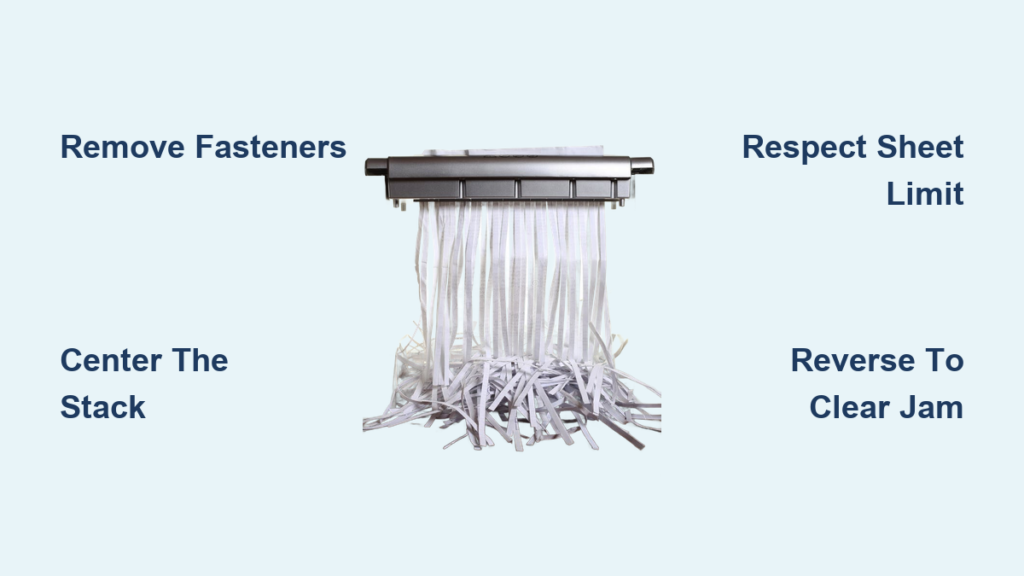
Prevent Jams and Overloads
Most jams come from overfeeding, especially with micro-cut models.
Best practices include:
- Never exceed sheet capacity
- Avoid staples, paper clips, and thick cardboard
- Shred plastic media (CDs, cards) separately if possible
- Use auto-reverse feature to clear minor jams
Clean Dust and Debris Monthly
Micro-cut shredders generate fine particles that can:
- Clog sensors
- Cause static buildup
- Reduce motor efficiency
Unplug the unit and perform these cleaning steps:
- Wipe interior with a dry cloth
- Use compressed air to clear blade housing
- Empty bin before it reaches three-quarters full
Waste Management and Recycling Facts
Shredded paper can be recycled, but with caveats.
Can You Recycle Shredded Paper
Yes, but consider these factors:
- Short fibers limit reuse to low-grade products (e.g., egg cartons, insulation)
- Plastic contamination (from cards/CDs) disrupts pulping
- Many curbside programs reject loose shredded paper due to sorting issues
Solutions for proper disposal:
- Place shredded paper in a clear, sealed bag labeled “shredded paper”
- Use a recycling drop-off center that accepts it
- Separate plastic shreds if your shredder does not have dual bins
Eco-Friendly Disposal Alternatives
- Composting: Shredded newsprint (non-glossy) can be composted in moderation
- Packaging material: Reuse for shipping or pet bedding
- Industrial baling: Large offices use shredder-baler systems to compress waste into recyclable bales
Always remove staples, plastic windows from envelopes, and non-paper items before recycling.
Historical Lessons That Shaped Shredder Security

The evolution of shredder cut types was not just technological; it was driven by real-world failures and legal shifts.
Iran Hostage Crisis: A Wake-Up Call
In 1979, U.S. embassy staff in Tehran used strip-cut shredders to destroy sensitive documents. After the takeover, Iranians reconstructed thousands of pages by hand, publishing them as “Documents from the U.S. Espionage Den.”
This incident proved strip-cut was inadequate for national security, pushing governments toward cross-cut and micro-cut systems.
California v. Greenwood: The Legal Turning Point
The 1988 Supreme Court ruling in California v. Greenwood declared that garbage left at the curb has no Fourth Amendment protection. This meant discarded documents could be searched legally, sparking widespread adoption of personal and business shredders.
Laws like HIPAA (1996) and FACTA (2003) later codified secure disposal, making shredding a legal necessity.
DARPA Shredder Challenge
The U.S. Defense Advanced Research Projects Agency offered $50,000 to reconstruct shredded puzzles. The winning team used automated image analysis and crowdsourcing to solve it in 33 days.
The takeaway is that even fine shreds can be reassembled with enough time and technology, reinforcing the need for micro-cut or multi-step destruction.
Key Takeaways for Choosing Paper Shredder Cut Types
The paper shredder cut type you choose defines your data is vulnerability. Strip-cut is fast but insecure, suitable only for junk mail and non-sensitive waste. Cross-cut (P-4) balances protection and performance for most users, making it the ideal choice for home offices and small businesses handling bank statements, tax documents, and customer records. Micro-cut (P-5 and above) provides essential protection for sensitive industries like healthcare, legal, finance, and government, where compliance with HIPAA, GDPR, and other regulations demands the highest security levels.
Match your shredder to your data is sensitivity, maintain it properly with regular oiling and cleaning, and stay compliant with privacy laws. When in doubt, err on the side of over-shredding, because your identity depends on it.
Frequently Asked Questions About Paper Shredder Cut Types
What is the most secure paper shredder cut type?
Micro-cut shredders offer the most secure cut type, producing particles as small as 5 mm² (P-7 level). At this level, reconstruction is considered forensically impractical without state-level resources. These are used by government agencies, military facilities, and organizations handling classified or highly sensitive data.
What does DIN 66399 mean for shredder security?
DIN 66399 is an international standard that classifies shredder security into seven levels (P-1 to P-7) based on particle size. P-1 offers the lowest security (12 mm strips), while P-7 provides the highest (≤ 5 mm² particles). This standard helps users select the appropriate shredder for their data protection needs.
Can strip-cut shredders be used for personal documents?
No, strip-cut shredders should never be used for personal documents containing any sensitive information. Their long strips (3 mm to 12 mm wide) retain readable text and can be easily reassembled. Only use strip-cut for junk mail, flyers, and other non-sensitive paper waste.
How often should I oil my cross-cut or micro-cut shredder?
Cross-cut and micro-cut shredders should be oiled every 15 to 20 minutes of continuous use or after shredding 100 to 200 sheets. Regular oiling prevents paper dust buildup, reduces blade wear, and minimizes jam frequency. Use only shredder-specific oil, not WD-40 or other household lubricants.
What is the difference between cross-cut and micro-cut shredders?
Cross-cut shredders slice paper both vertically and horizontally, producing particles around 4 mm to 10 mm (P-3 to P-4 security). Micro-cut shredders make significantly more cuts, reducing paper to tiny 2 mm to 5 mm particles (P-5 to P-7 security). Micro-cut offers nearly impossible reconstruction but operates slower with lower sheet capacity and higher maintenance needs.
Can shredded paper be recycled?
Yes, shredded paper can be recycled, but with limitations. The short fiber length means it is typically used for low-grade products like egg cartons or insulation. Place shredded paper in a clear, sealed bag labeled for recycling, and remove any plastic contamination from credit cards or CDs before recycling.