
Binding machines are essential tools for creating professional documents, reports, presentations, and manuals. Whether you work in an office, school, or print shop, the right machine transforms loose pages into polished, durable publications. With several types of binding machines available, each offering unique benefits, choosing the best one can feel overwhelming. This guide breaks down every major binding style, including plastic comb, coil, wire, thermal, and VeloBind systems. You will learn how each works, which applications they suit best, and what features matter most when shopping for a binding machine.
Match Machine to Binding Style
Choosing the right binding machine starts with understanding the style you need. Each type produces a different look, function, and durability level, so your decision depends on document use, volume, and appearance.
Choose Based on Document Appearance
The visual impact of your final document matters, especially for client-facing materials. Different binding styles deliver distinct aesthetics:
- Plastic comb binding offers a clean, budget-friendly look ideal for internal reports
- Double loop wire binding gives a polished, professional finish perfect for proposals
- Coil binding provides a dynamic, colorful appearance great for notebooks
- Thermal binding delivers a sleek, hardcover-style finish that mimics published books
- VeloBind creates a rigid, archival-quality spine suited for legal manuals
Start by asking who will see the document and what impression it should make.
Consider Daily Output Needs
Your binding volume determines whether a manual or electric model works best:
- Low volume (a few books per day): Machines with 5 to 12 sheet punch capacity like the PB 100 or PC 100 are sufficient
- Medium volume (dozens per day): Models with 15 to 20 sheet punch capacity, such as PB 400 or PC 2300, improve speed
- High volume (large production runs): Electric punch machines like PB 500 or PC 2500 reduce effort and increase throughput
Electric models save time and physical strain when handling frequent or thick jobs.
Match to Document Use Case
How the document will be used directly affects your choice:
- For note-taking or frequent reference: Coil binding allows pages to lay flat and rotate fully
- For formal client presentations: Double loop wire or thermal binding offers a premium look
- For temporary or editable content: Plastic comb binding is reusable, with pages that can be added or removed easily
- For long-term storage or filing: VeloBind provides unmatched durability and security
Think about how users will interact with the document before deciding.
Evaluate Short-Term vs. Ongoing Need
Are you buying for a one-time project or continuous use?
- Short-term needs: Entry-level models like PB 200 or OffiBind offer cost-effective solutions
- Ongoing use: Invest in higher-end models with adjustable margins, disengageable dies, and longer warranties such as USI 210 or WireMac
- Large-scale operations: Electric machines with separate handles and high punch capacity maximize efficiency
Plan for future needs to avoid upgrading too soon.
Plastic Comb Binding Machines
Plastic comb binding is the most widely used method in schools, offices, and print shops due to its simplicity, low cost, and reusability.
Why Use Plastic Comb Binding?
This style uses a round, multi-pronged plastic comb inserted into 19 evenly spaced holes along the edge of standard letter-size paper. It is ideal for everyday documents like handbooks, syllabi, and training guides.
Key advantages include:
- Combs can be opened and closed for editing
- Available in various colors to match branding
- Affordable consumables
- Supports up to 425 sheets with a 2″ comb
Plastic comb binding works best for general office use, student reports, and editable manuals.
Top Models and Features
| Model | Punch Capacity | Max Binding | Electric? | Key Features |
|---|---|---|---|---|
| PB 100 | 5 sheets | 5/8″ | No | Entry-level, fixed margin |
| PB 200 | 8 sheets | 5/8″ | No | Adjustable margin, oversized cover support |
| PB 400 | 20 sheets | 2″ | No | Adjustable margin depth, disengage dies |
| PB 500 | 20 sheets | 2″ | Yes (punch) | Electric punch, high capacity |
| USI 210 | 10 sheets | 2″ | No | 2-year warranty, adjustable settings |
| USI 213 | 10 sheets | 2″ plastic / 1/2″ wire | No | Dual-purpose: plastic or wire comb |
Look for adjustable margin guides and disengageable dies if you bind different paper sizes.
How to Bind With a Plastic Comb Machine
- Align paper using the side and back guides
- Punch holes using the manual or electric punch
- Open the plastic comb using the machine’s comb opener
- Insert opened comb into punched sheets
- Close the comb by twisting it shut
Always test punch a single sheet first to ensure correct alignment.
Plastic Coil Binding Machines
Coil binding uses a continuous plastic spiral that runs through round holes punched along the document edge. It is known for allowing documents to lay completely flat when open.
Benefits of Coil Binding
Coil binding offers several practical advantages:
- Pages rotate fully and won’t tear out
- Ideal for cookbooks, manuals, and notebooks
- Lays flat, perfect for writing or referencing
- Color options enhance visual appeal
- Binding capacity ranges from 30 to 120 sheets with coil diameters from 1/4″ to 9/16″
Unlike combs, coils are not reusable. Once closed, they must be cut to remove.
Compare Manual vs. Electric Inserters
Coil binding machines differ mainly in how the coil is inserted:
- Manual inserter: You feed the coil by hand (e.g., PC 100)
- Electric inserter: Motor automatically threads the coil (e.g., PC 2000, PC 2500)
Electric inserters speed up production and reduce errors, especially for long documents.
Top models include:
- PC 2000: Manual punch, electric inserter, 12-sheet capacity, 30mm binding max
- CoilMac-EPI: Electric punch and inserter, A5 size, adjustable margin, 25mm binding max
- PC 2500: Electric punch and binder, 12-sheet capacity, A4 size, 16mm binding max
For high-volume shops, electric models save significant time.
How to Bind With a Coil Machine
- Punch paper using the correct hole pattern (typically 4:1 or 5:1 pitch)
- Cut coil to match document length using a coil crimping tool
- Crimp ends of the coil to prevent unraveling
- Insert coil into first hole
- Feed coil through all holes manually or with electric inserter
- Close ends with crimping pliers
Always verify coil size matches document thickness. Too small risks over-compression; too large causes loose binding.
Double Loop Wire Binding Machines
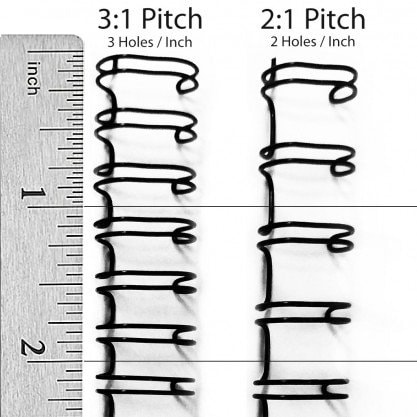
Double loop wire (also called wire comb or twin-loop wire) uses a metal wire with two interlocking loops per hole. It offers a professional finish and excellent page retention.
3:1 vs. 2:1 Pitch: What’s the Difference?
The pitch refers to how many holes are punched per inch:
- 3:1 pitch: 3 holes per inch (32 holes on 11″ paper)
- Smaller holes, tighter spacing
- Best for thinner documents (10 to 120 sheets)
- Comb sizes range from 3/16″ to 9/16″
- 2:1 pitch: 2 holes per inch (21 holes on 11″ paper)
- Larger holes, wider spacing
- Handles thicker books (20 to 250 sheets)
- Comb sizes range from 1/4″ to 1-1/8″
Never mix pitches. Use only the wire that matches your machine’s punch pattern.
Top Wire Binding Machines
| Model | Pitch | Punch Capacity | Binding Max | Features |
|---|---|---|---|---|
| WireMac | 3:1 | 20 sheets | 9/16″ | Adjustable margin, disengage dies, separate handles |
| Fellowes WB150 | 3:1 | 15 sheets | 9/16″ | Compact, A5 size |
| OffiWire | 3:1 or 2:1 | 10 sheets | 9/16″ or 7/8″ | Dual-pitch option |
Machines like the WireMac offer separate handles for punching and binding, giving more control during operation.
How to Wire Bind a Document
- Set margin based on wire size
- Punch paper with correct pitch (3:1 or 2:1)
- Open the wire using a wire closer tool
- Insert open wire into punched holes
- Close the wire using a wire closer or built-in closer
Use a wire closer gauge to ensure even pressure and a neat finish.
Thermal Binding Machines
Thermal binding uses heat-activated adhesive spines to create a seamless, hardcover-like finish without visible holes or coils.
Advantages of Thermal Binding
Thermal binding delivers a premium result with minimal effort:
- No punching required, just insert pages into the cover
- Clean, professional look ideal for proposals and reports
- Spine is printed with titles for easy identification
- Standard covers support 5 to 120 page bindings
- The Fellowes TB450 supports up to 700 pages
- Pages won’t fall out or rotate
This method works best for client presentations, legal documents, and annual reports.
How Thermal Binding Works
- Load pre-glued spine cover into the machine
- Insert document into the cover
- Apply heat (usually 3 to 5 minutes) to activate the adhesive
- Cool under pressure (1 to 2 minutes) to set the bond
No special skills needed. Just align and press.
Best Thermal Model: Fellowes TB450
Key specifications include:
- Binding capacity: Up to 700 pages
- No punching required
- Automatic heating and cooling cycle
- One-year warranty
- Letter-size only
Thermal binding costs more due to higher-priced covers, but the result justifies the investment for high-stakes documents.
VeloBind Binding Machines
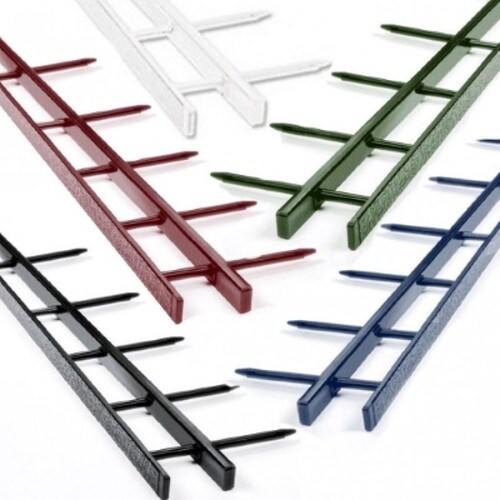
VeloBind is the most secure binding method, ideal for permanent, archival-quality documents.
Why Choose VeloBind?
VeloBind offers unmatched security and durability:
- Uses durable plastic strips with 4 or 11 prongs
- Heat-seals the entire spine for tamper resistance
- Creates a rigid, book-like spine
- Supports books up to 3 inches thick
- Excellent for filing and long-term storage
Common users include legal firms, government agencies, and technical documentation teams.
How VeloBind Works
- Punch 4 or 11 holes through document and cover
- Insert VeloBind strip through holes
- Snap top into place
- Machine trims excess prongs and heat-seals the spine
The result is a stiff, tamper-proof document that won’t come apart.
VeloBinder Model Specs
- Max size: Letter
- Punch capacity: 20 sheets
- Binding max: 1″ (binds up to 3″ thick with multiple strips)
- Warranty: 1 year
This model is best for high-security, high-durability needs where document integrity is critical.
Compare Binding Capacities Side-by-Side
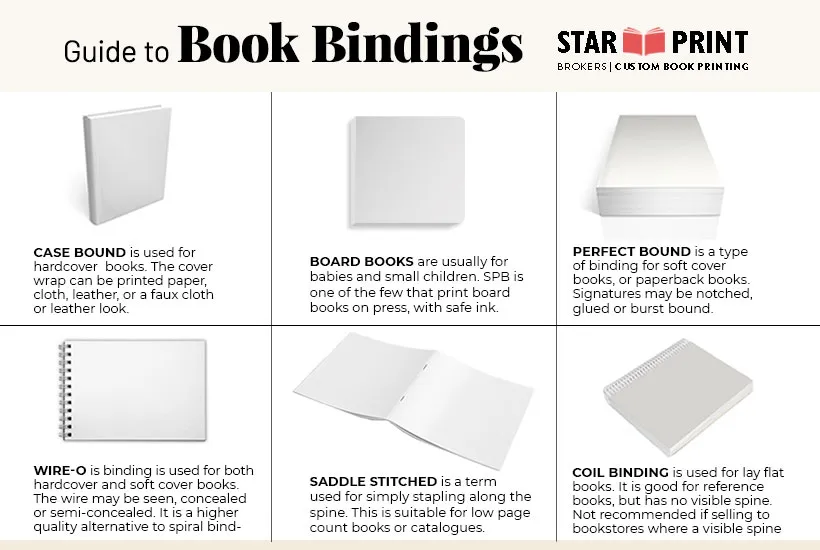
Understanding capacity helps match the machine to your workload.
| Binding Type | Min Sheets | Max Sheets | Max Thickness | Element Size |
|---|---|---|---|---|
| Plastic Comb | 12 | 425 | 2″ | 3/16″ to 2″ |
| Coil | 30 | 120 | 9/16″ | 1/4″ to 9/16″ |
| 19-Hole Wire Comb | 25 | 210 | 1″ | 1/4″ to 1″ |
| 3:1 Wire | 10 | 120 | 9/16″ | 3/16″ to 9/16″ |
| 2:1 Wire | 20 | 250 | 1-1/8″ | 1/4″ to 1-1/8″ |
| VeloBind | N/A | ~3″ thick | 3″ | 1/4″ wide strips |
| Thermal | 5 | 700 (TB450) | 1.5″ to 2″ | Pre-glued spine |
Actual capacity depends on paper weight.
Machine Features That Matter
Beyond binding type, key features affect usability and flexibility.
Electric vs. Manual Operation
- Manual: Lower cost, suitable for light use
- Electric punch: Reduces effort, faster for stacks
- Electric inserter (coil/wire): Speeds up the binding process
For frequent use, electric models pay for themselves in time saved.
Adjustable Margin Guide
This feature allows you to change the distance between the paper edge and the holes. It is critical when binding different-sized documents or using various cover stocks.
Found on: PB 400, USI 210, WireMac, and CoilMac models.
Disengageable Dies
This lets you turn off specific punching pins to accommodate smaller paper sizes such as A5 in an A4 machine. It increases versatility.
Available on: PB 400, PB 500, USI 210, and WireMac.
Separate Handles
Independent levers for punching and binding give greater control and reduce misalignment.
Standard on: PB 400, WireMac, and PC 2300.
Warranty Length
Most models offer a 1-year warranty. Exceptions include:
- USI 210 and USI 213: 2-year standard, with extended options available
- OffiBind: 6-month warranty (the shortest offered)
Longer warranties often reflect higher build quality.
Pick the Right Machine by Use Case
Use this quick guide to choose fast based on your needs.
Budget-Friendly Office Binding
Best Choice: Plastic comb (PB 200 or OffiBind)
– Low upfront cost
– Easy to use
– Reusable combs
Professional Client Proposals
Best Choice: Double loop wire (WireMac) or Thermal (Fellowes TB450)
– Wire offers a sleek, secure, professional look
– Thermal provides a premium, book-like finish
Notebooks That Lay Flat
Best Choice: Coil binding (PC 2000 or CoilMac-EPI)
– Full page rotation
– Ideal for writing and referencing
High-Security Manuals
Best Choice: VeloBind (VeloBinder)
– Tamper-resistant
– Heat-sealed spine
– Long-term durability
High-Volume Production
Best Choice: Electric models (PB 500, PC 2500)
– Faster punching
– Reduced physical strain
– Higher daily output
Frequently Asked Questions About Binding Machines
What is the most common type of binding machine?
Plastic comb binding machines are the most widely used type, especially in schools, offices, and print shops. They are affordable, easy to operate, and allow pages to be added or removed, making them ideal for editable documents.
Which binding machine is best for professional presentations?
Double loop wire and thermal binding machines are best for professional presentations. Wire binding offers a polished, secure look, while thermal binding creates a sleek, hardcover-style finish perfect for high-stakes proposals and reports.
What is the difference between 3:1 and 2:1 wire binding pitch?
The pitch refers to the number of holes punched per inch. A 3:1 pitch creates 32 holes on an 11″ sheet for thinner documents, while a 2:1 pitch creates 21 holes for thicker books. Machines and wire must match the same pitch to function properly.
Can coil-bound pages be removed and reinserted?
No, coil binding is permanent. Once a coil is closed, it must be cut to be removed, and a new coil is required to re-bind the document. This makes coil binding best for finished projects rather than editable ones.
What binding machine is best for high-security or archival documents?
VeloBind machines are the most secure option. They use plastic strips with 4 or 11 prongs that are heat-sealed to create a tamper-proof, rigid spine. This makes VeloBind ideal for legal documents, government records, and long-term archival storage.
How do I choose between manual and electric binding machines?
Choose manual machines for light, occasional use to save on cost. Choose electric models if you bind dozens of documents daily, work with thick stacks, or want to reduce physical strain. Electric punch and inserter functions significantly speed up production.
Final Tips for Choosing the Right Binding Machine
- Test before you buy: Try punching and binding a sample stack to confirm the machine fits your needs
- Check compatibility: Ensure the machine matches your most-used paper size, whether A4, Letter, or Legal
- Buy extra supplies: Stock up on combs, coils, or covers so you are never caught short
- Consider space: Larger machines need dedicated desk area
- Look for service support: Brands with good customer service save headaches later
Choosing the right types of binding machines comes down to balancing appearance, volume, durability, and budget. With this guide, you now have the knowledge to select the perfect machine for any project, whether it is a single report or a daily print run. Start by identifying your most common document type, match it to the binding style that fits your needs, and invest in a model with the features that will save you time and effort in the long run.